
Images are protected under the Creative Commons CC BY-NC-ND 4.0 license; they may be freely used for educational and outreach purposes, non-commercially, with proper attribution to the author and without modification.
Plant Description
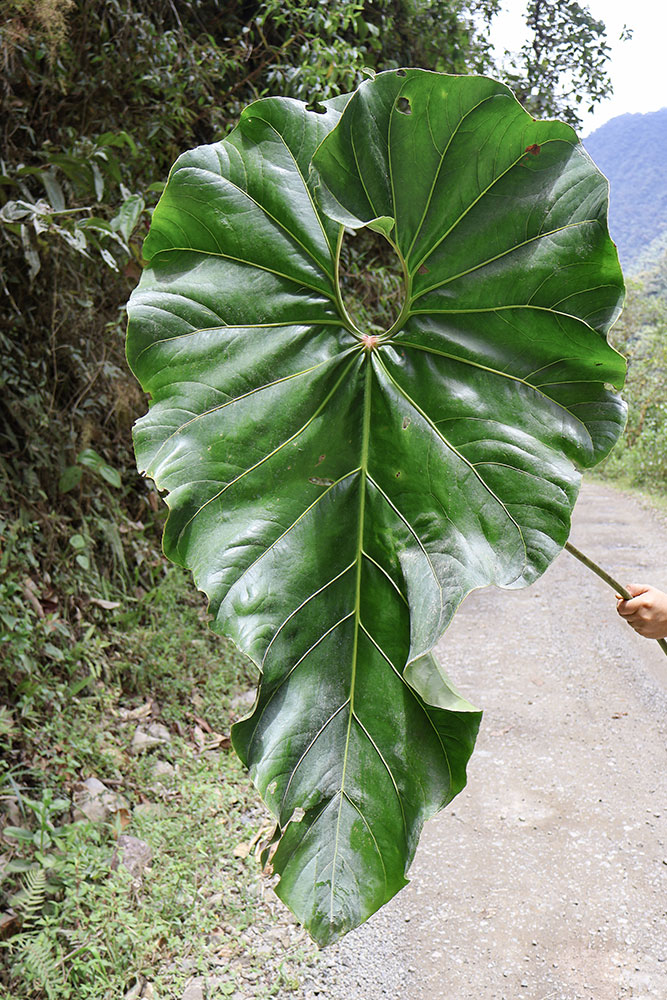
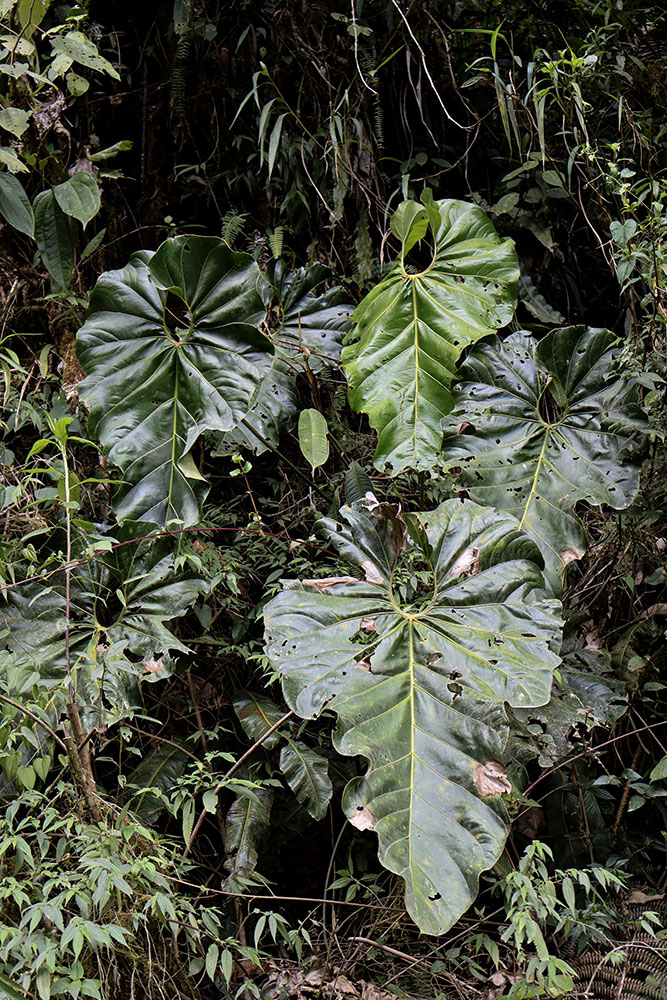
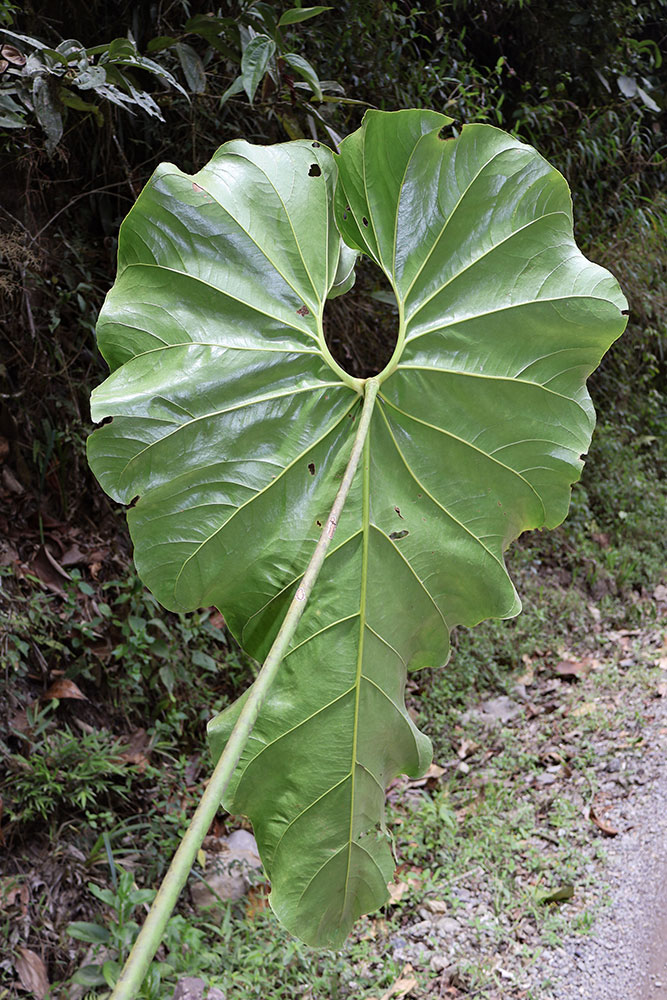
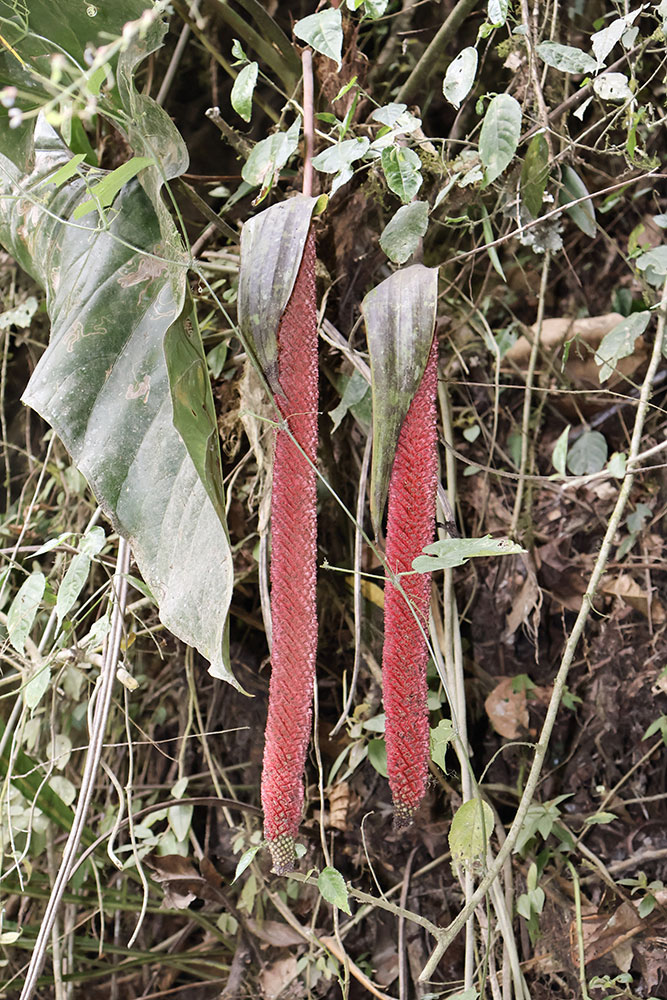
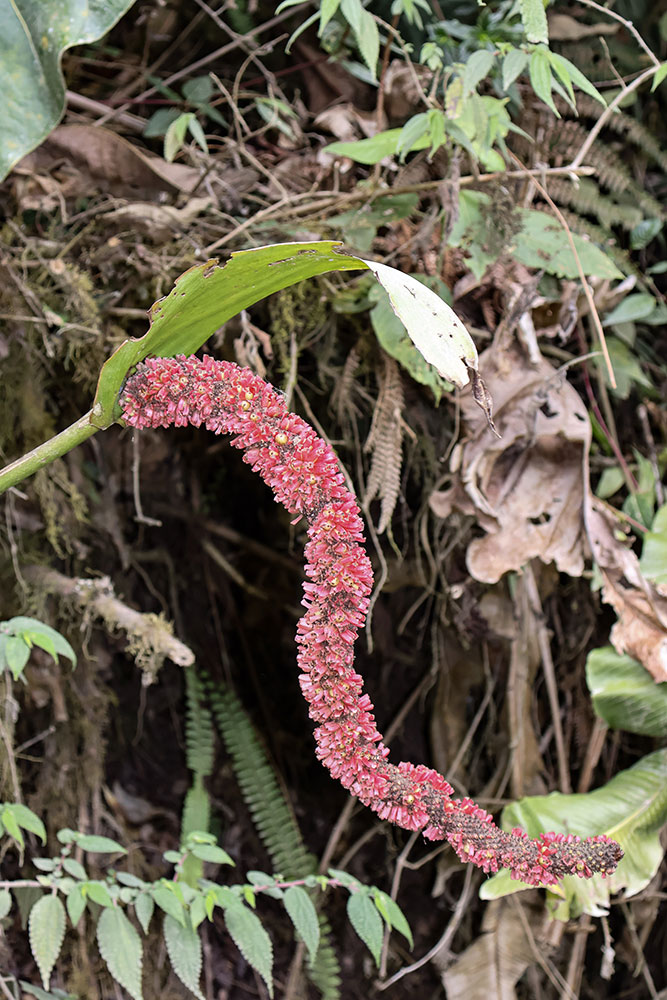
Robust terrestrial herb, with stems exceeding 1 m in length and 4–5 cm in diameter; internodes short. Cataphylls 21–52 cm, semi-intact, dark brown with persistent fibers forming a dense fibrous mass. Petioles terete, slightly sulcate toward the apex, flexible, medium green, weakly glossy, (83–)92–165 cm; geniculum red-purple, 3–5 cm. Leaf blades subcoriaceous, ovate-sagittate, 44–88(–103) × 31–72 cm, approximately 1.3 times longer than wide, dark green and weakly glossy above, paler below. Anterior lobe broad; posterior lobes directed toward the base, somewhat incurved; sinus deep. Basal veins 10–12 pairs, the first pair free, the remainder fused forming a naked posterior rib; lateral veins 9–10 pairs. Inflorescence erect; peduncle 48–74 cm. Spathe green, cucullate, with reddish or purplish tints. Spadix stipitate, 21–66 cm, dark violet to reddish brown, long-attenuate. Infructescence pendent, robust, red, with berries often partially covered by prominent tepals.
Geographic distribution
Native species, widely distributed in Ecuador and extending into Colombia, with probable presence in Peru. In the province of Pichincha, it shows a broad distribution in the northwestern region, with records from Nono, Tandayapa, Pacto, Gualea, and surrounding areas. It inhabits western montane forest and eastern montane forest, in humid environments with high forest cover.
Conservation Status
A preliminary assessment of Vulnerable (VU) is proposed for this species in Ecuador. Although it has a broad distribution, some populations may be affected by habitat loss and road expansion.
Ecological Notes
Terrestrial species associated with high-humidity environments, frequent on slopes and in areas with constant water saturation. Its fleshy, pendent infructescences, with conspicuous red berries, indicate zoochorous dispersal by birds and bats.
Recommended citation:
Zambrano Cevallos, R. 2026. Anthurium giganteum Engl.. Araceae of Pichincha. Jardín Botánico de Quito. Available at https://jardinbotanicoquito.com/en/project/anthurium-giganteum-engl/. Accessed: November 23, 2026.