
Images are protected under the Creative Commons CC BY-NC-ND 4.0 license; they may be freely used for educational and outreach purposes, non-commercially, with proper attribution to the author and without modification.
Plant Description
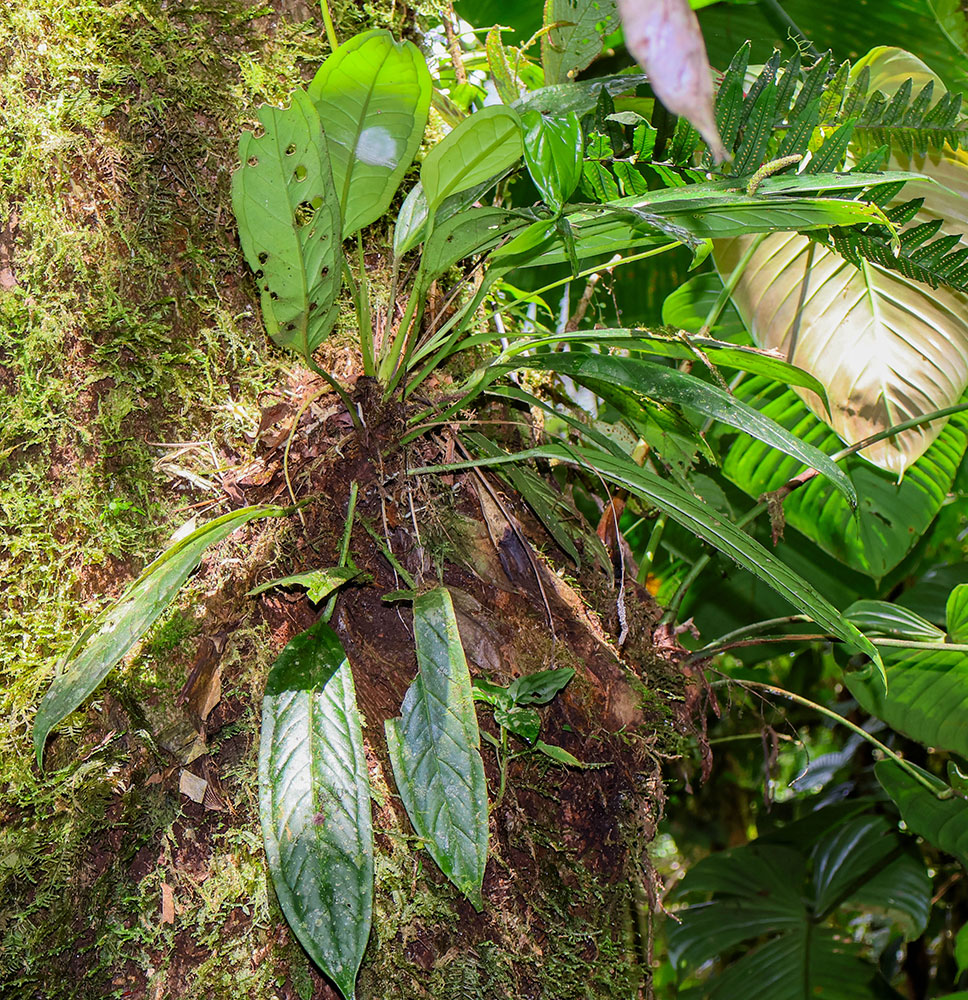
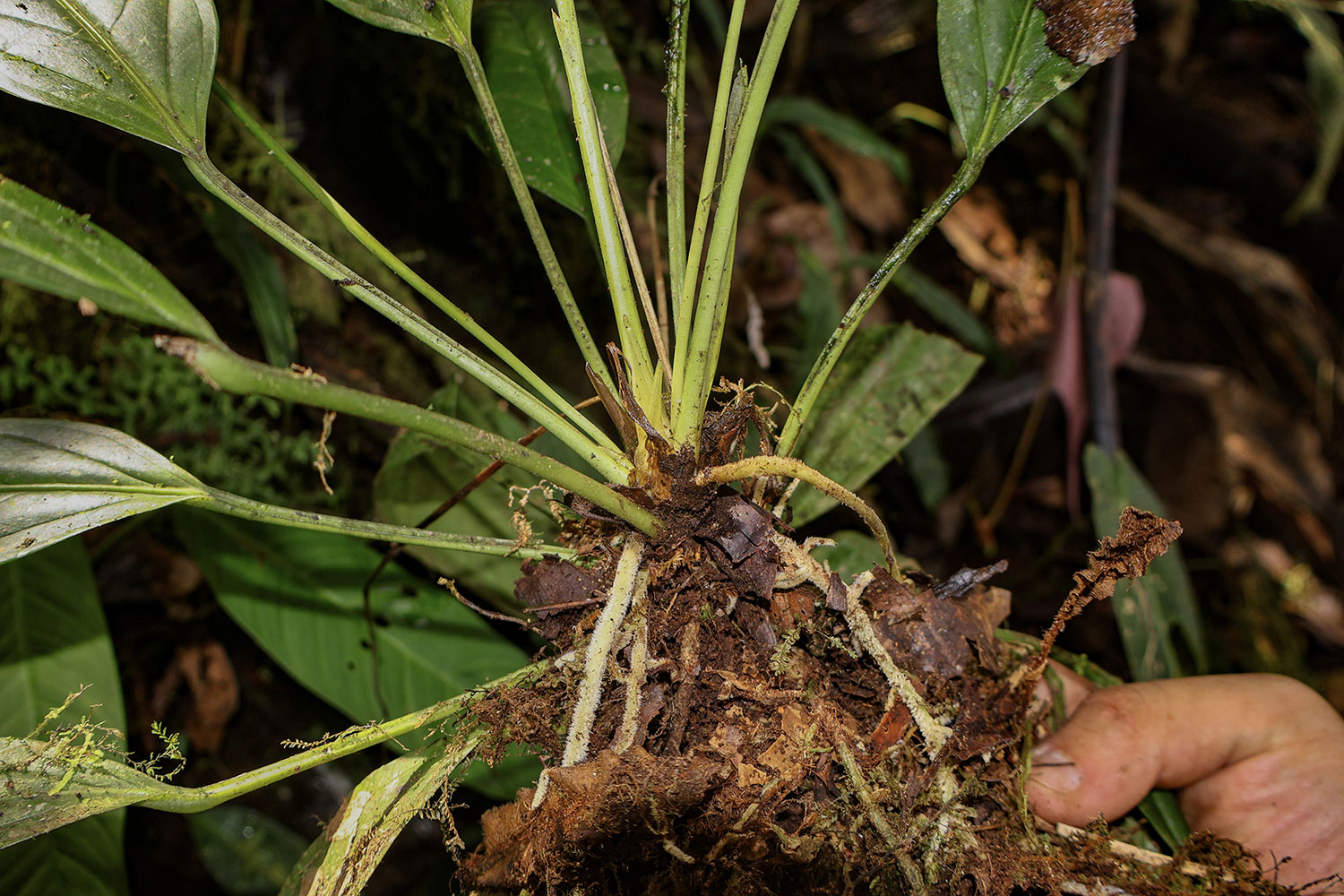
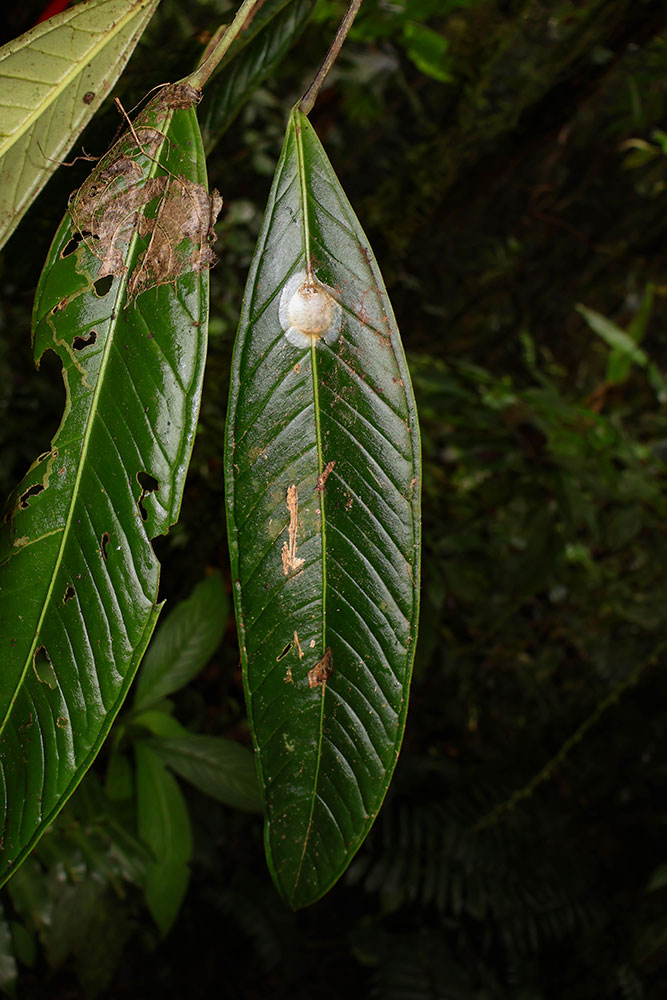
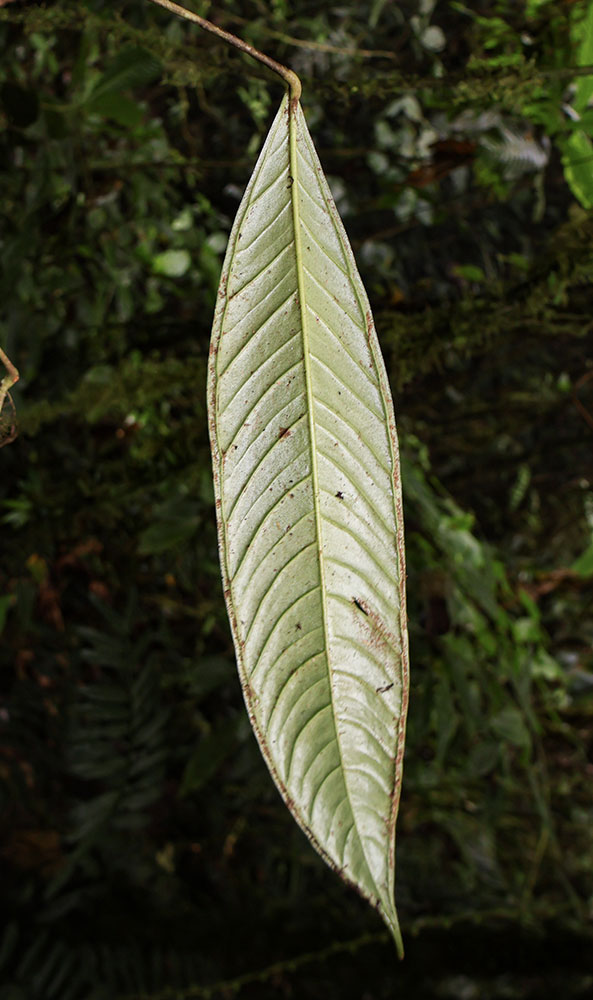
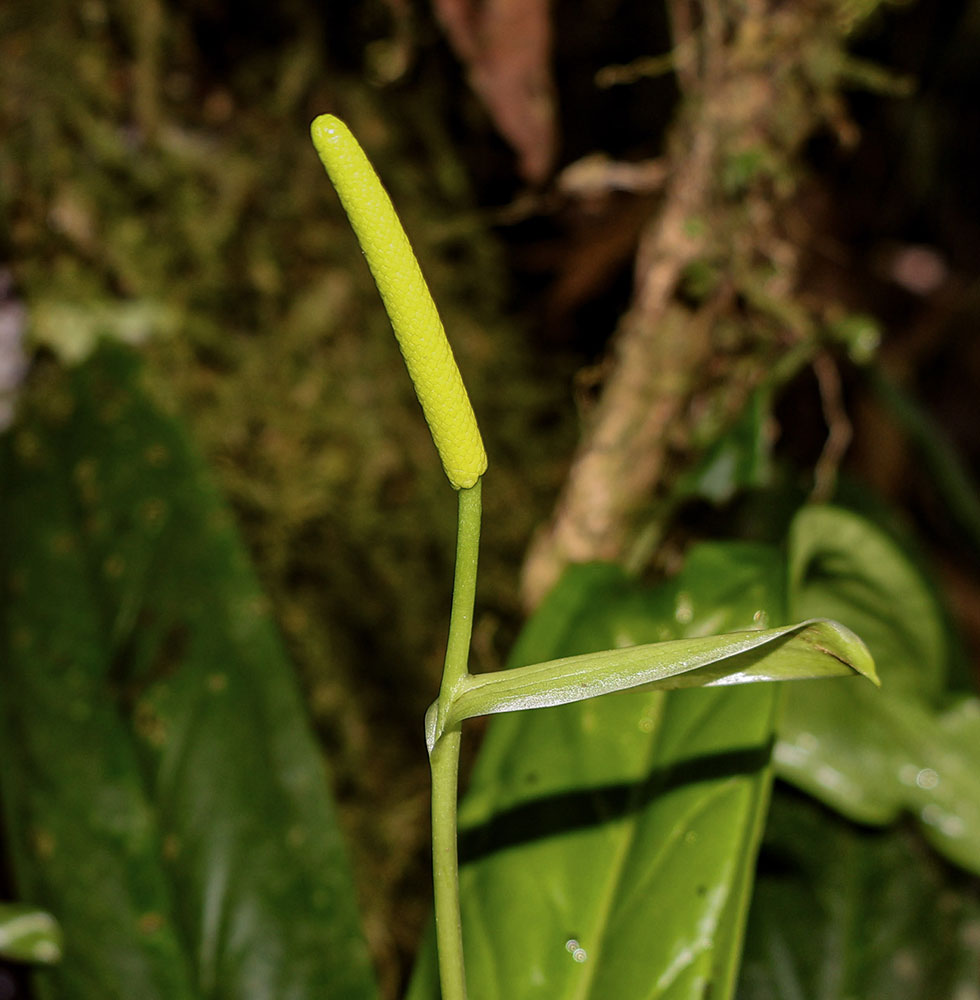
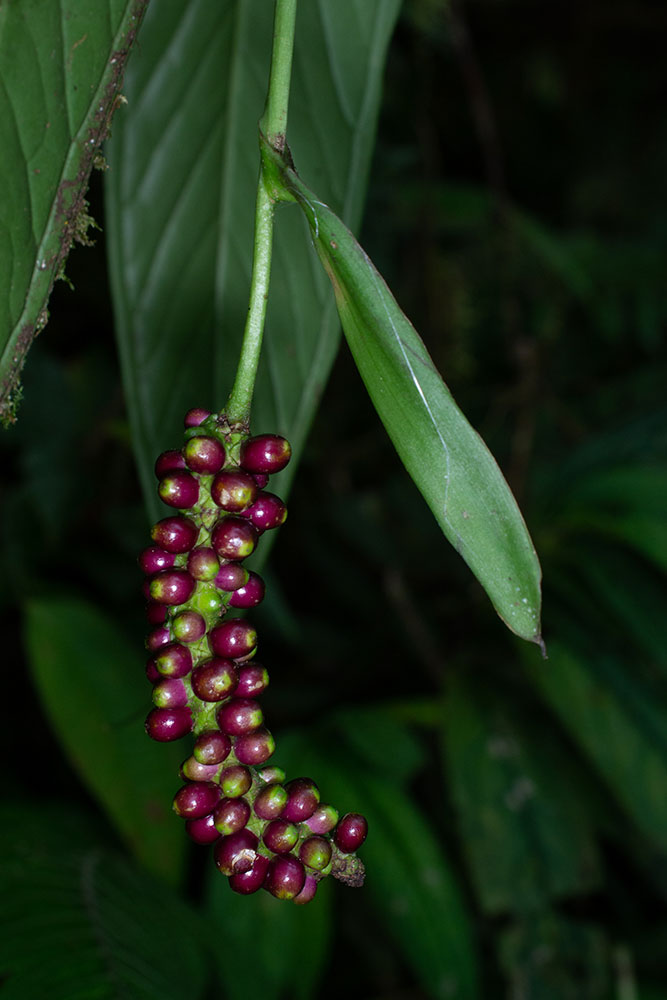
Understory epiphyte with short internodes, 0.8–1.5 cm long. Cataphylls 5–9 cm, soon deciduous, persisting as sparse pale fibers at the stem base. Petiole 8.8–12.2 cm, shallowly and broadly sulcate; geniculum short, weakly differentiated. Leaves erect to spreading, arranged in a fan-like pattern. Blades oblong to narrowly elliptic, 18.6–28.2 cm long by 4.2–7.2 cm wide, 4–4.5 times longer than wide, subcoriaceous to coriaceous. Apex gradually acuminate; base attenuate to weakly obtuse. Adaxial surface dark green, subvelvety to weakly glossy; abaxial surface paler green and glossy. Primary lateral veins 9–11 per side, arising at 30–40°, arching toward the apex. Collective vein visible from near the base, running close to the margin. Inflorescence erect. Peduncle long, 26–42 cm. Spathe lanceolate, green and spreading, 3.5–7.2 cm. Spadix cylindric, 3.7–5.9 cm, yellow turning yellow-green at maturity, supported by a long stipe (3.3–3.5 cm). Infructescence with emergent obovoid berries, dark red to burgundy.
Geographic distribution
Endemic species to Ecuador, currently known only from the Mashpi Reserve, where it has been documented by several collections from its type locality. It is distributed in the northwestern part of the Metropolitan District of Quito, at around 1560 m elevation. It inhabits western piedmont forest, in humid environments with high forest cover.
Conservation Status
A preliminary assessment of Critically Endangered (CR) is proposed for this species in Ecuador. Its known distribution is extremely restricted, and its populations may be exposed to habitat loss and transformation. Further field surveys will be necessary to better determine its distribution and reassess its conservation status.
Ecological Notes
Grows as an epiphyte in the understory, associated with humid environments and dense tree cover. Observed individuals do not form dense aggregations. Its pendent infructescences, with conspicuous red berries, suggest dispersal by birds.
Recommended citation:
Zambrano Cevallos, R. 2026. Anthurium roquesevillae R. Zambrano & Croat. Araceae of Pichincha. Jardín Botánico de Quito. Available at https://jardinbotanicoquito.com/en/project/anthurium-roquesevillae-r-zambrano-croat-2/. Accessed: November 23, 2026.