
Images are protected under the Creative Commons CC BY-NC-ND 4.0 license; they may be freely used for educational and outreach purposes, non-commercially, with proper attribution to the author and without modification.
Plant Description
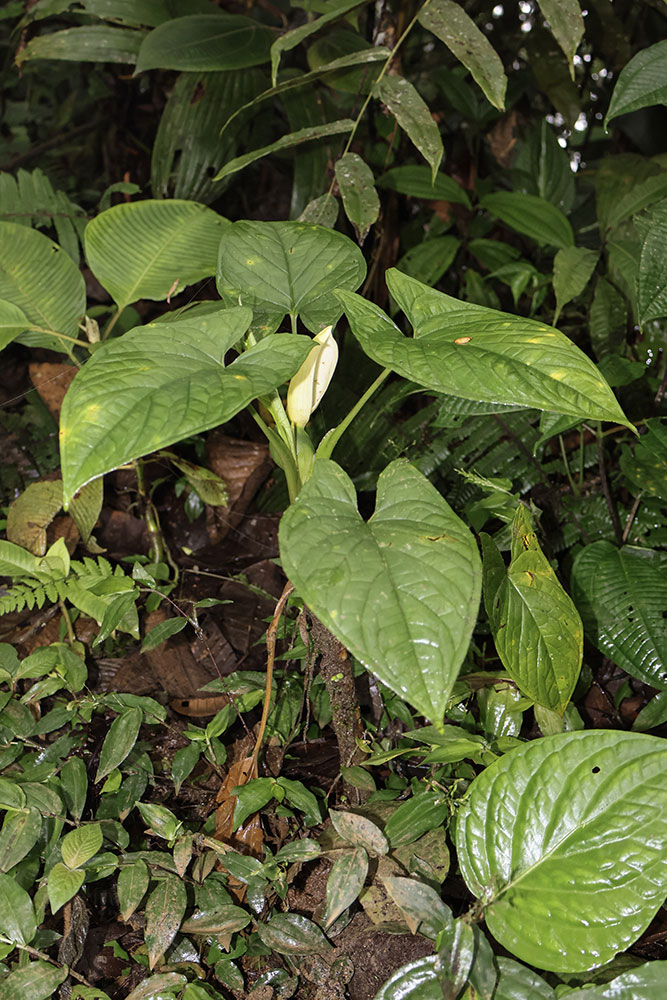
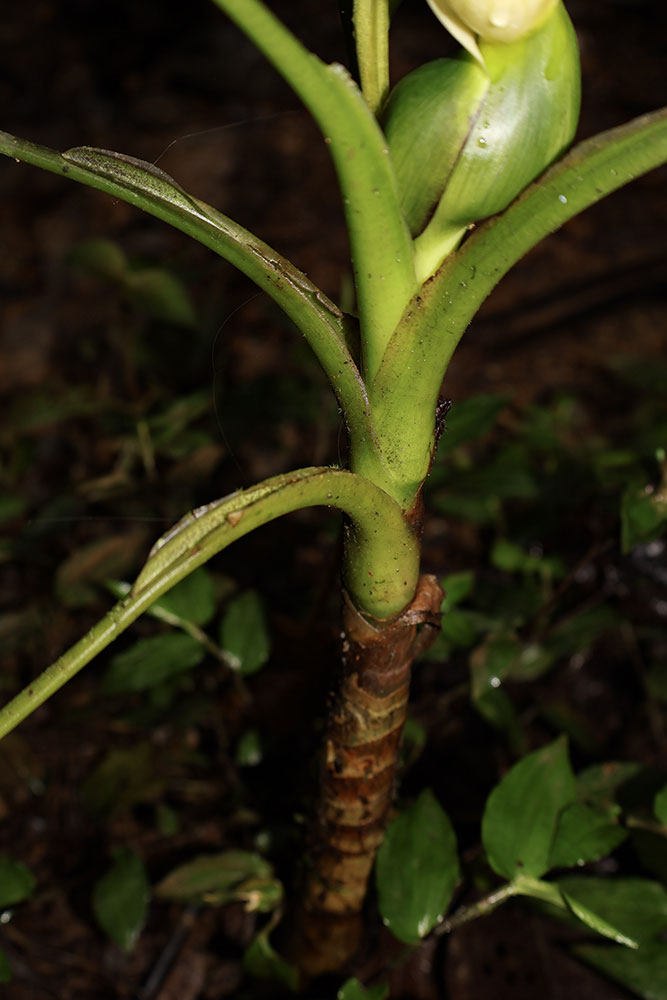
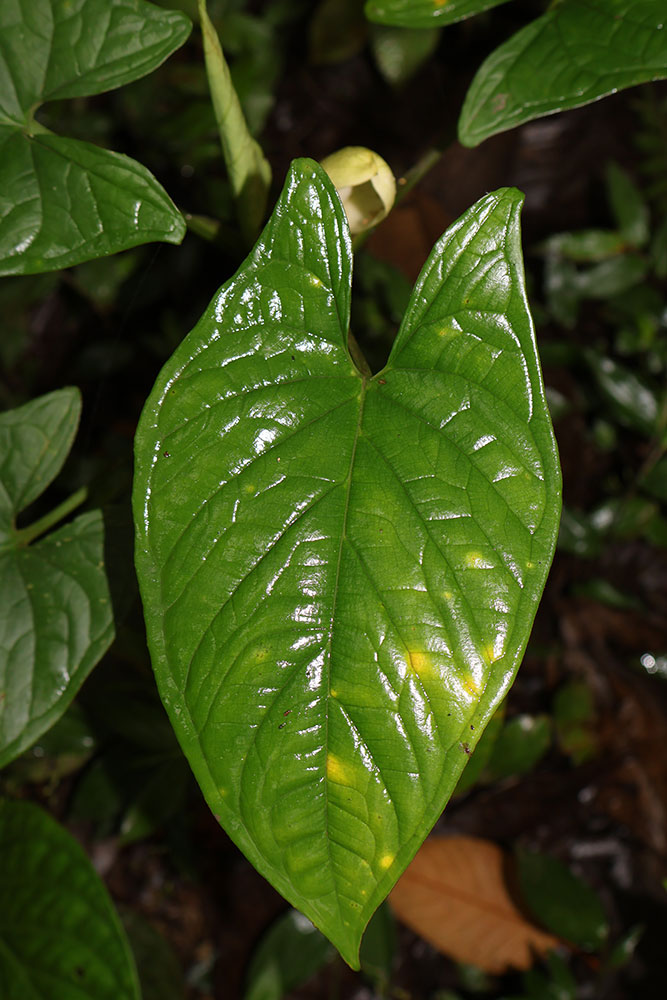
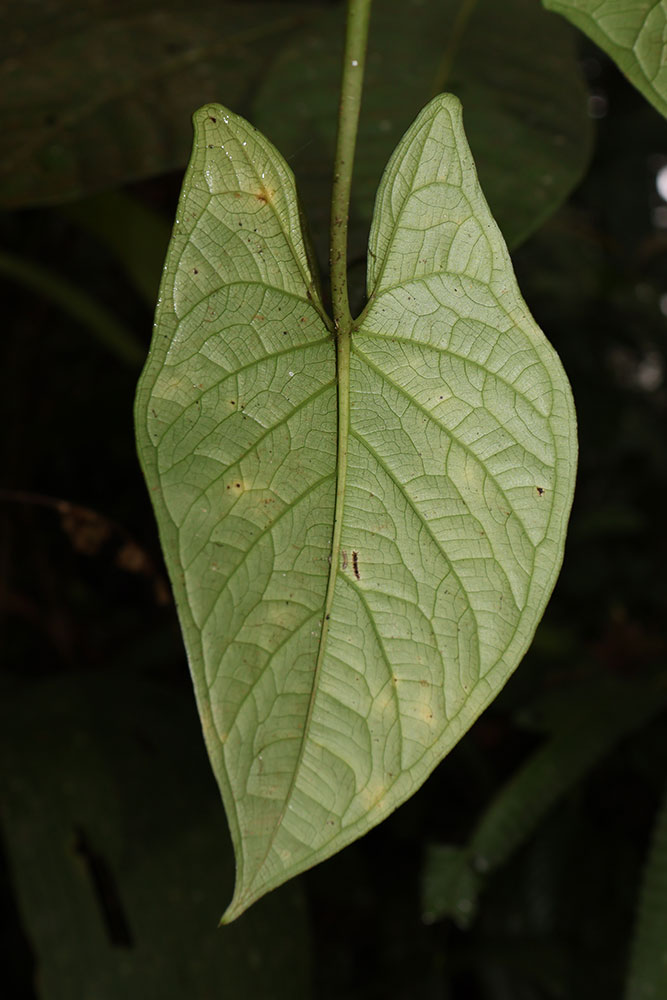
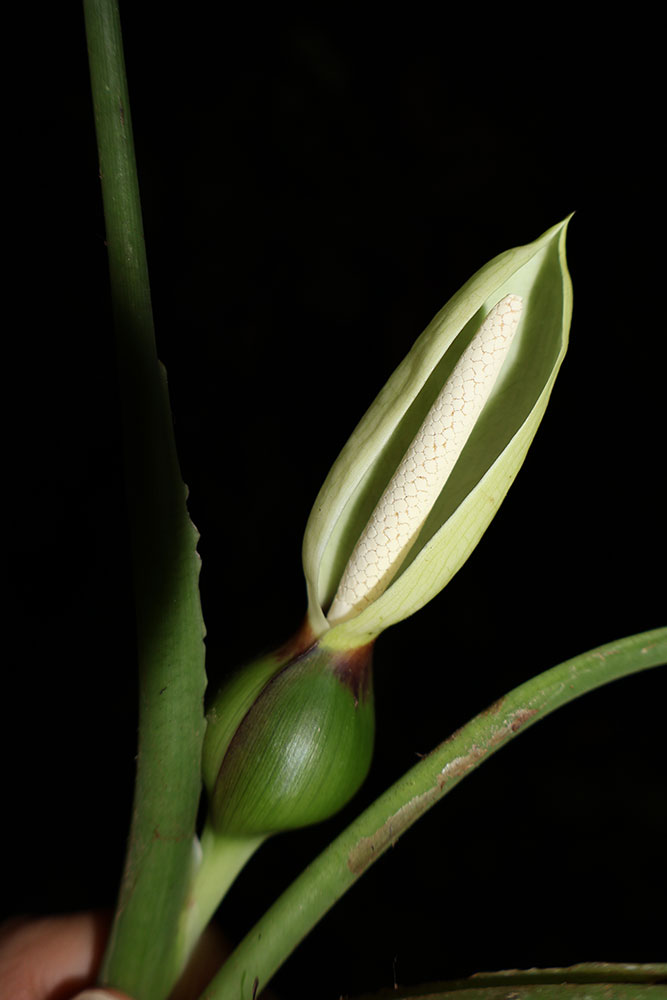
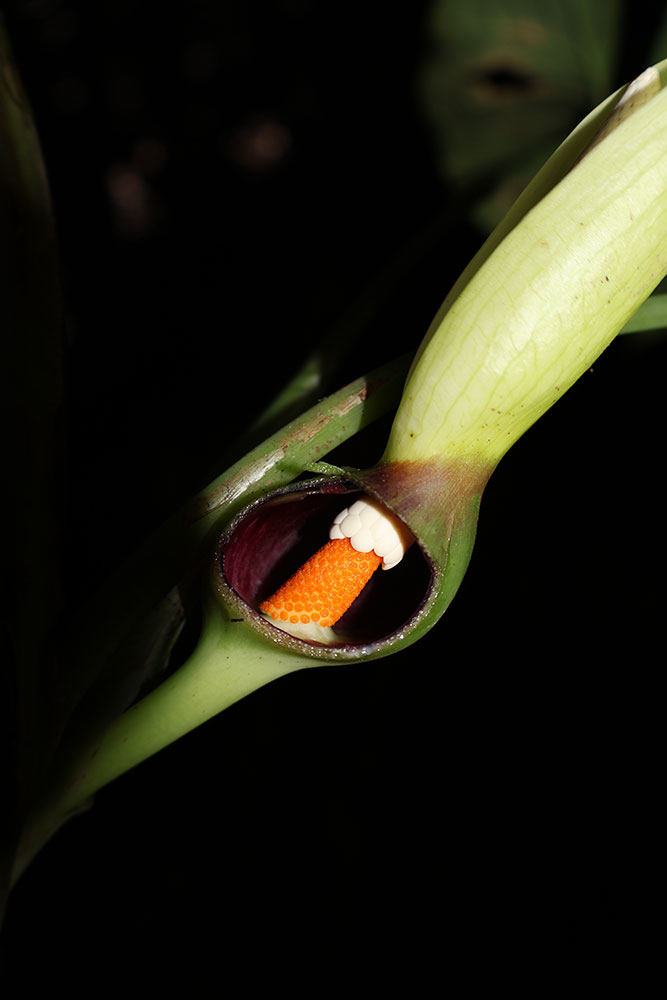
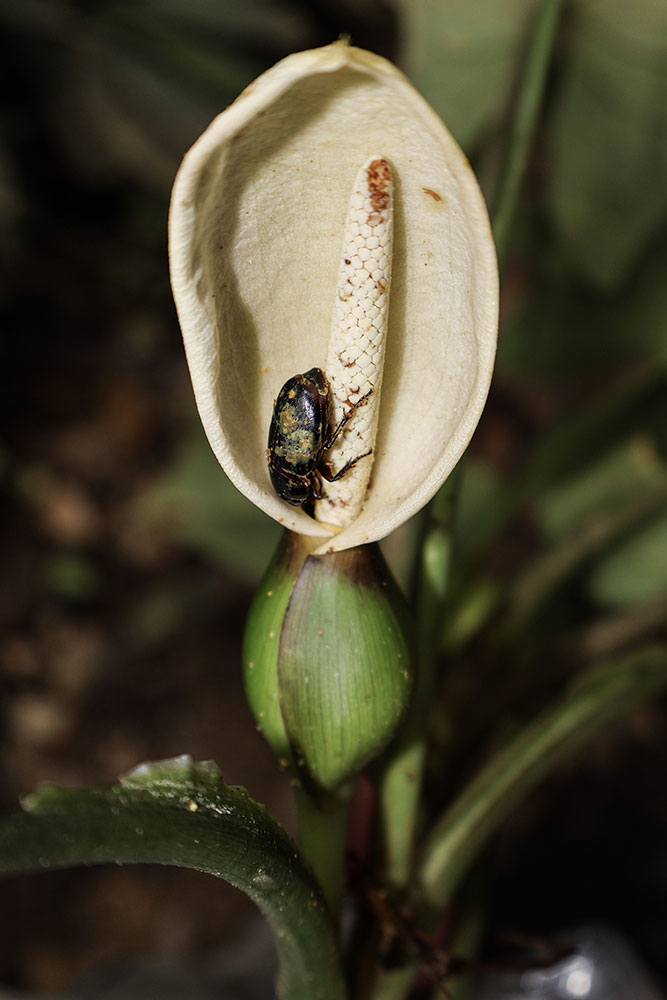
Terrestrial herb 0.7–0.9 m tall, with stems 40–60 cm long. Internodes short, 1–2 cm long, pale green. Cataphylls marcescent, persisting semi-intact as brown fibers. Petioles 16.5–26.5 cm, terete to subterete, medium to dark green, with a sheath covering between one-third and two-thirds of their length. Leaf blades cordate-sagittate, 17.5–24.0 cm long by 9.5–12.5 cm wide, 1.7–2 times longer than wide, subcoriaceous. Upper surface dark green, matte to slightly velvety; lower surface pale green and matte. Anterior lobe well developed; posterior lobes 4–7.2 cm long, obtusely pointed at the apex. Sinus spatulate to weakly hippocrepiform. Primary veins 2–4 pairs; basal veins 3–4 pairs, with the first pair free to the base and the second pair fused for 0.8–1.5 cm. One inflorescence per axil. Peduncle 4.5–6.0 cm. Spathe 7.5–11.0 cm long; tube medium green externally, becoming slightly violet-purple toward the constriction and dark violet internally. Spadix 9–10 cm long, with a bright orange pistillate portion. Infructescence erect, with creamy yellow berries.
Geographic distribution
Endemic species to Ecuador, currently known only from its type locality within the Mashpi–Tayra Reserve. It is recorded in the northwestern part of the Metropolitan District of Quito, at approximately 917 m elevation. It inhabits western piedmont forest, in humid environments with high forest cover.
Conservation Status
A preliminary assessment of Endangered (EN) is proposed for this species in Ecuador. It has a restricted distribution and, although part of its populations occurs within a private protected area, its habitat is under pressure from deforestation, mining, road development, livestock grazing, and agriculture. Further field surveys are needed to better determine its actual distribution.
Ecological Notes
Flowers throughout the year, with flowering peaks in July and September. Pollination is carried out by beetles of the tribe Cyclocephalini. The inflorescence emits a mint-citrus fragrance that reaches its greatest intensity at the beginning of the night.
Recommended citation:
Zambrano Cevallos, R. 2026. Xanthosoma quitensis R. Zambrano & Croat. Araceae of Pichincha. Jardín Botánico de Quito. Available at https://jardinbotanicoquito.com/en/project/xanthosoma-quitensis-r-zambrano-croat-2/. Accessed: November 23, 2026.