
Images are protected under the Creative Commons CC BY-NC-ND 4.0 license; they may be freely used for educational and outreach purposes, non-commercially, with proper attribution to the author and without modification.
Plant Description
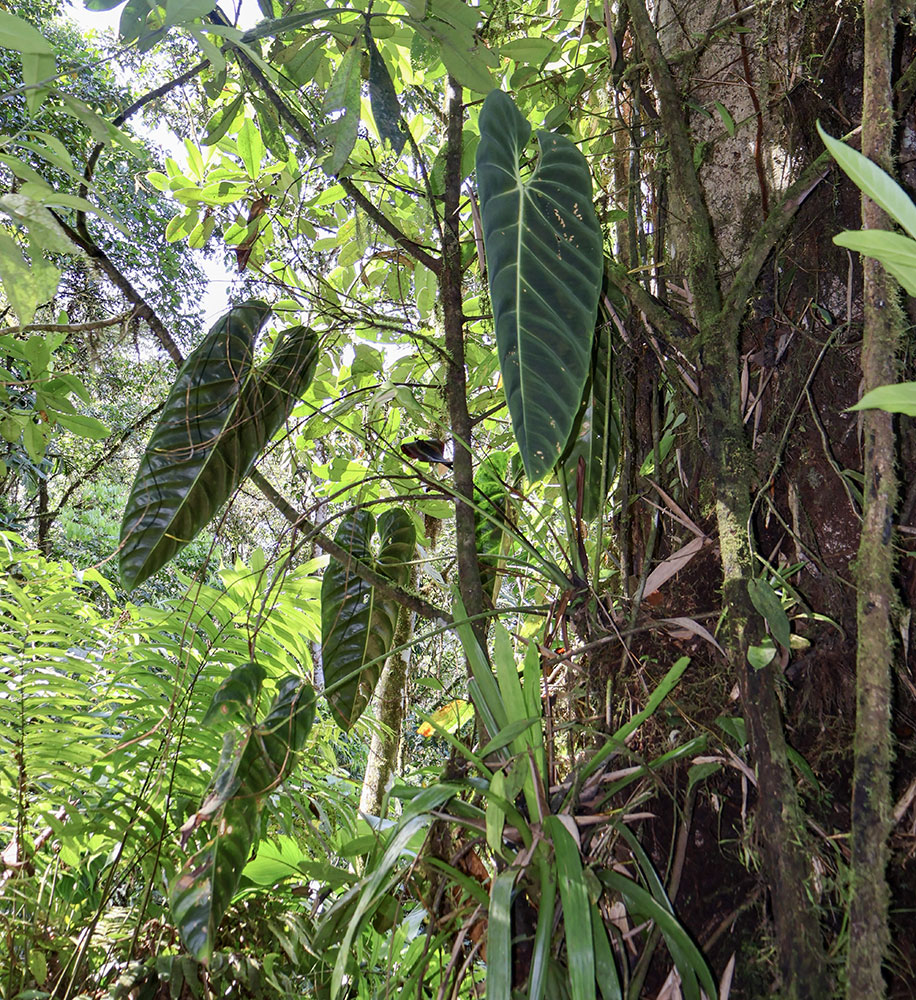
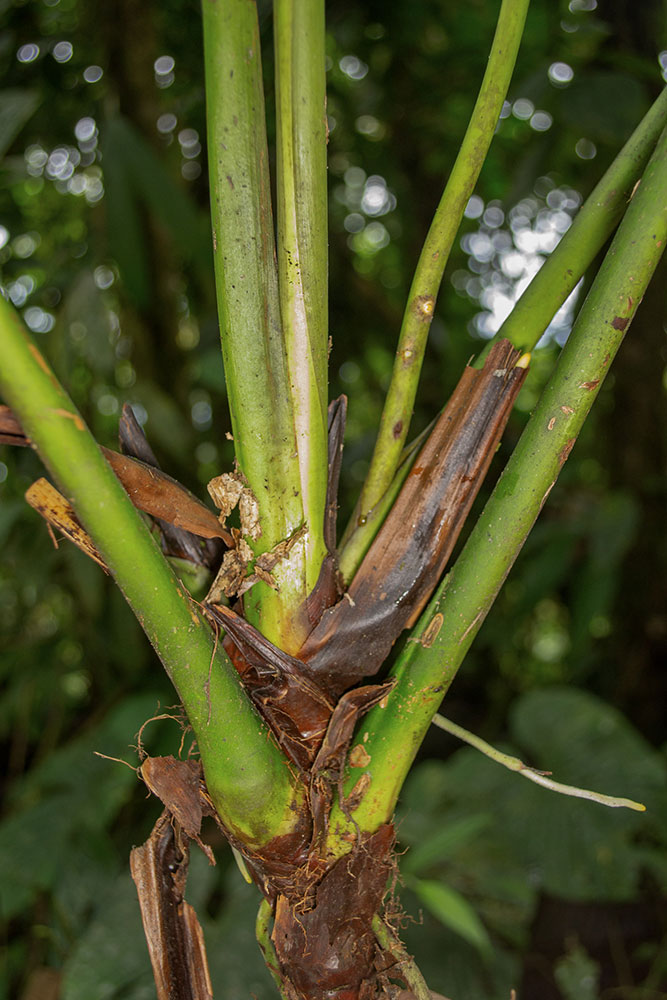
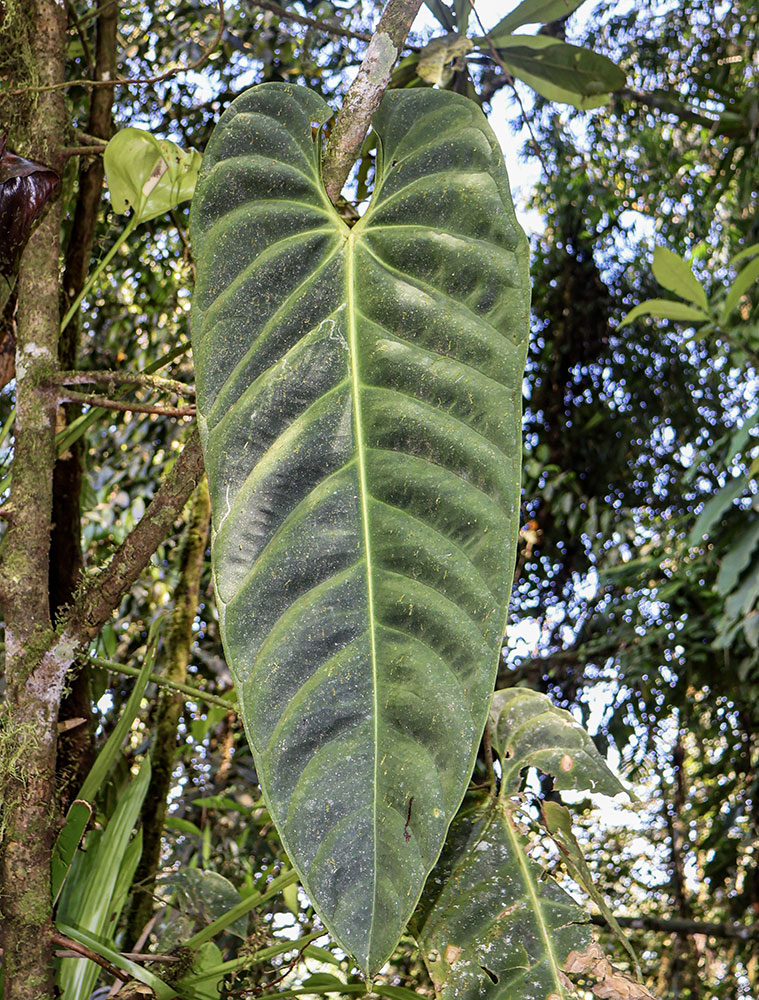
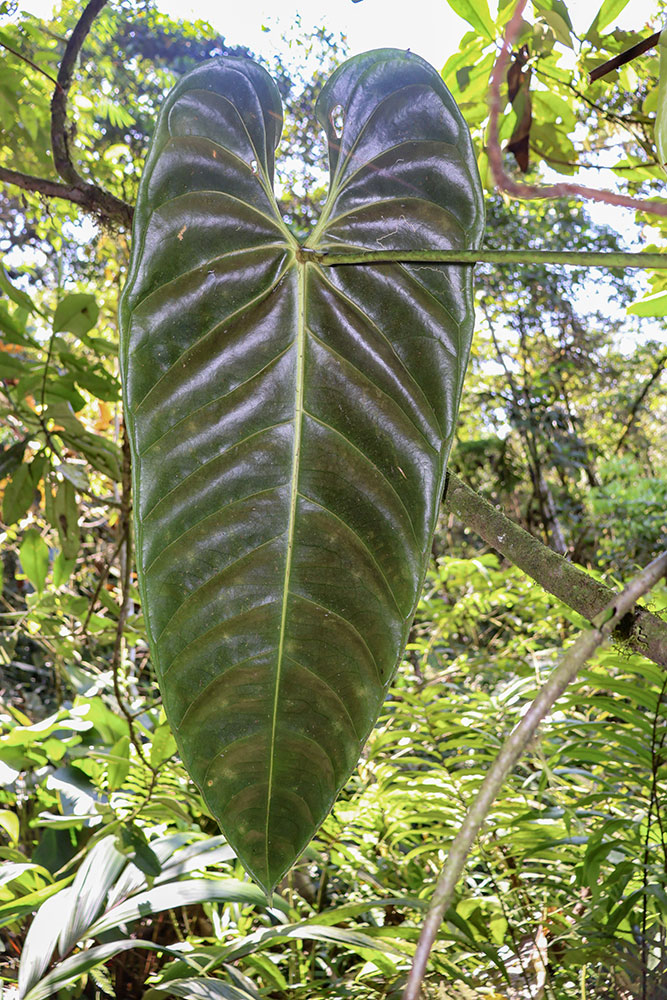
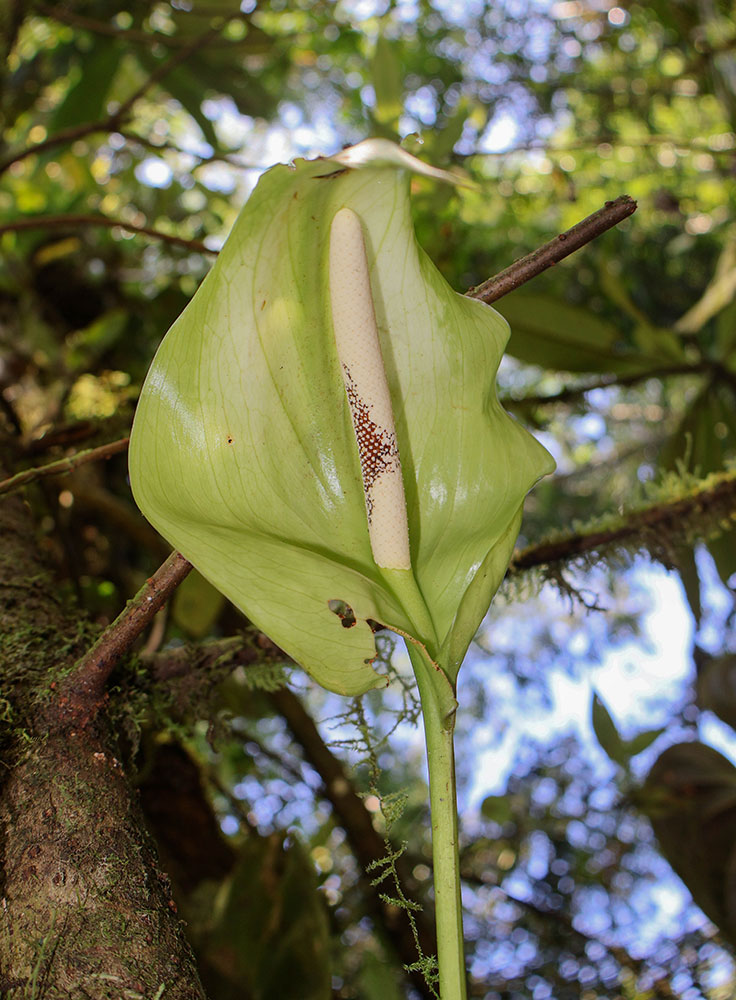
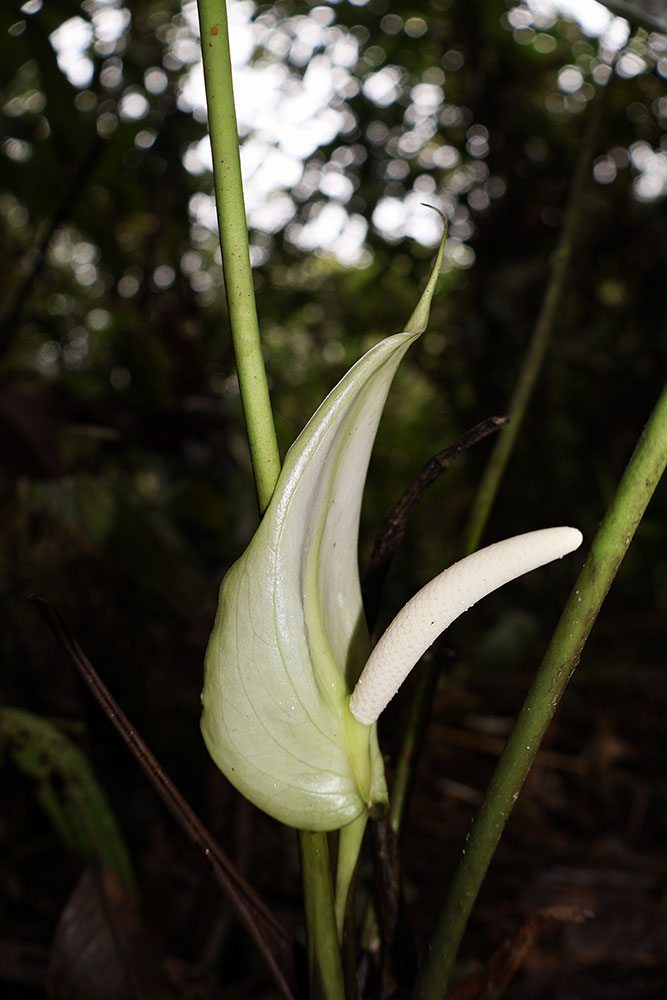
Epiphytic or terrestrial herb, with short internodes, wider than long, 1–5 cm in diameter, drying reddish brown. Cataphylls up to 25 cm, persistent and intact, subcoriaceous, turning brown when dry. Petioles 36–81 cm, terete, medium to dark green, slightly glossy. Leaf blades triangular-ovate, (28)42–59 × 13.5–25 cm, 2–2.5 times longer than wide, cordate to sagittate at the base, subcoriaceous to coriaceous, dark green and matte to velvety above, paler, reddish to purplish and glossy below; upper surface finely granular, lower surface with faint dark punctation. Anterior lobe broad; posterior lobes short, directed inward; sinus spatulate, deep. Basal veins 5–6 pairs, the first 2 pairs free to the base, the remaining fused; primary lateral veins 6–8 pairs, emerging at an angle of 45–60°. Collective vein arising from one of the lower basal veins, close to the margin. Inflorescence erect to spreading; peduncle 27–69 cm. Spathe oblanceolate, 10–19 cm, generally cucullate, green externally and sometimes with reddish to purplish tones internally. Spadix cylindrical, 6.5–15 cm, cream to whitish. Infructescence not observed.
Geographic distribution
Native species, distributed from southern Colombia to Ecuador. It has been recorded in the department of Nariño (Colombia) and in Ecuador in the provinces of Esmeraldas, Pichincha, and Cotopaxi. In Pichincha, it has been recorded in the northwestern region, in localities between approximately 600 and 1045 m elevation. It inhabits western piedmont forest, characterized by humid conditions and high forest cover.
Conservation Status
A preliminary assessment of Endangered (EN) is proposed for this species in Ecuador. Although it is known from several localities in western Ecuador, its populations are exposed to the loss and transformation of humid forests and may also be affected by the collection of wild individuals due to its ornamental value.
Ecological Notes
Epiphytic or terrestrial species, frequent in high-humidity environments. It may occur with relative abundance and occupy both the understory and lower strata on trees. It is a species of high ornamental value, which may imply collection pressure in some localities.
Recommended citation:
Zambrano Cevallos, R. 2026. Anthurium esmeraldense Sodiro. Araceae of Pichincha. Jardín Botánico de Quito. Available at https://jardinbotanicoquito.com/en/project/anthurium-esmeraldense-sodiro-2/. Accessed: November 23, 2026.